
Advanced Sports Betting Strategies: From Beginner to Pro
 Available in US
The journey from recreational bettor to profitable professional is longer and harder than most people realize. I'm talking years, not months. Thousands of bets tracked meticulously, hundreds of hours studying odds movements and market dynamics, countless expensive lessons learned through blown bankrolls and humbling reality checks. Anyone selling you shortcuts is lying.
But here's what makes this path worth walking---sports betting is one of the few fields where genuine skill compounds over time into sustainable edge. Unlike casino games with fixed house advantages, sports betting markets contain inefficiencies you can exploit through superior analysis, faster information processing, or better understanding of probability than the average bettor. The edge exists. The question is whether you're willing to do the work required to find it.
Most bettors never progress past beginner stage. They bet recreationally, chase exciting parlays, follow tipsters, and lose money slowly without really understanding why. Some reach intermediate level---they're profitable occasionally, understand basic concepts, but haven't developed systematic approach or emotional discipline for consistent success. Very few reach professional level where betting becomes reliable income source rather than expensive hobby.
This guide maps the progression from beginner fundamentals through intermediate strategies to advanced professional techniques. We're not holding back or gatekeeping information behind expensive courses. You'll learn the actual strategies professionals use, why they work, where edges exist in modern betting markets, and critically, the psychological and practical obstacles that prevent most people from implementing these strategies successfully despite knowing them intellectually.
Fair warning---reading this won't automatically make you profitable. Knowledge is prerequisite, not guarantee. Execution, discipline, and sustained effort determine results. But if you're serious about sports betting as skill-based pursuit rather than entertainment, this framework provides roadmap from wherever you are now toward where you want to be.
Foundational Betting Principles That Never Change

Expected value is the single most important concept in betting. Everything else is secondary. EV is simple formula: probability of winning multiplied by amount you'd win, minus probability of losing multiplied by amount you'd lose. Positive EV means bet is profitable long-term. Negative EV means you're donating money to bookmakers. Zero EV means break-even.
The mental shift from results-oriented thinking to process-oriented thinking separates amateurs from professionals. Bad bettors evaluate bets based on whether they won. Good bettors evaluate bets based on whether they had positive expected value at the time they placed them. You can make correct bet and lose. You can make terrible bet and win. Individual results are noise. Process quality determines long-term outcomes.
This mindset is psychologically difficult because humans are wired to learn from immediate feedback. Bet wins, feels good, seems like correct decision. Bet loses, feels bad, seems like mistake. But in probabilistic domain like betting, immediate feedback is often misleading. The discipline is evaluating decision quality based on information available when you made it, not based on outcome you couldn't control.
Line shopping---comparing odds across multiple bookmakers and always taking best available price---is non-negotiable for serious betting. Difference between 1.90 and 2.00 odds seems trivial. Over hundreds of bets, it's difference between profitable year and break-even year. Professional bettors maintain accounts with five to ten bookmakers specifically for line shopping. It's free money sitting on the table if you're willing to click a few extra times.
The mathematics are brutal if you ignore this. Bet 100 pounds at 1.90 versus 2.00 on fifty-fifty proposition. At 1.90, you need to win 52.6% of bets to break even. At 2.00, you need to win 50%. That 2.6% difference in required win rate is enormous when compounded across hundreds of bets. You're literally making betting harder on yourself by accepting worse odds.
Specialization beats generalization almost always. Trying to bet everything---Premier League, NFL, NBA, tennis, horses---means you're expert in nothing. Professional bettors typically focus intensely on one or two sports, often specific leagues within those sports, sometimes specific bet types within those leagues. Deep expertise beats surface knowledge because edges in modern betting come from knowing markets better than bookmakers and other bettors, which requires focused study.
The appeal of diversification is spreading risk across uncorrelated bets. The reality is you're more likely to spread mediocrity across multiple areas where you lack edge rather than develop genuine advantage. Better to become elite in narrow domain than competent in broad domain.
Bankroll management determines survival regardless of skill. Brilliant handicapper with poor bankroll discipline goes broke. Mediocre bettor with excellent discipline stays in the game long enough to improve. The mathematics are unforgiving---bet too much per wager, and variance will eventually hit losing streak that craters your bankroll before long-term edge materializes.
Standard advice is risking one to two percent of bankroll per bet, adjusting as bankroll grows or shrinks. This sounds conservative and boring. It also works. Professional bettors with proven track records rarely risk more than three to five percent even on highest confidence bets. They've learned through painful experience that variance is more extreme than you think, and protecting downside matters more than maximizing upside.
Beginner Betting Strategies and Foundations
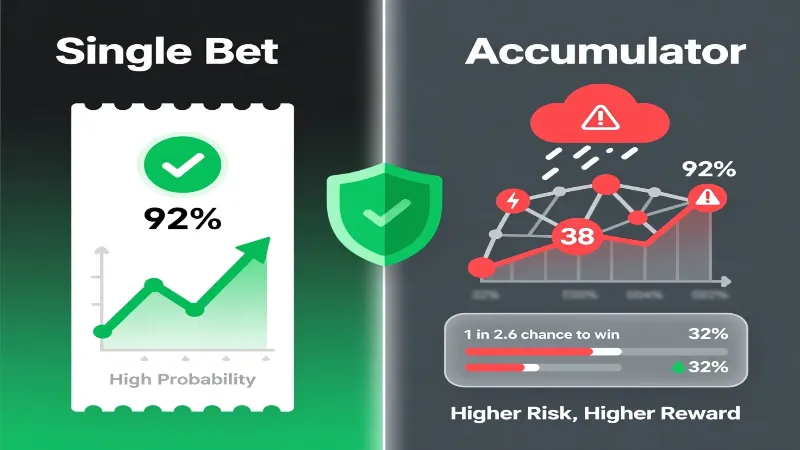
Starting with single bets rather than parlays is where everyone should begin, though most don't. Singles let you evaluate each bet independently, track which types of bets you're profitable at, and learn from mistakes without confusing variables. Parlays combine multiple bets with multiplied odds, which sounds appealing but dramatically reduces win probability and makes identifying edge nearly impossible.
The math on parlays is straightforward. Two-leg parlay where each bet has 60% win probability gives you 36% overall win probability. Three legs at 60% each drops to 21.6%. Five legs at 60% each is 7.8%. Most bettors wildly overestimate their win probability on individual bets, assume 70-80% when reality is 50-55%, then compound this error across multiple legs. Recipe for losing money consistently.
Singles have another massive advantage---you learn which bet types you're actually good at. Maybe you're profitable betting underdogs but lose money betting favorites. Maybe your over/under record is excellent but your match result bets lose. You'll never discover these patterns if every bet is tied up in parlays where you can't isolate what's working versus what's failing.
Focusing on one league or sport creates knowledge advantage over casual bettors. If you watch every Championship match, read detailed tactical analysis, track injury reports obsessively, and understand managerial tendencies, you know more than recreational bettor who bets Championship occasionally based on league table position. That knowledge gap is exploitable edge.
The strategy is depth over breadth. Don't bet Premier League on Saturday, Bundesliga on Sunday, Serie A on Monday. Bet Championship exclusively, or League One, or Scottish Premiership---something specific where you can develop genuine expertise that surpasses bookmaker's general models.
Basic research methodology means checking team news, recent form, head-to-head records, and tactical matchups before betting. This sounds obvious but most bettors skip it. They bet based on vibes, media narratives, or favorite team bias. Establishing systematic pre-bet research process creates immediate advantage over lazy majority.
Value betting against favorites and popular teams exploits public bias where casual bettors overbet popular teams, creating value on opponents. Manchester United or Liverpool playing away to mid-table team often has inflated odds on home side because public money floods favorite. This creates mathematical edge even if you know nothing about football.
The mechanism is supply and demand. Bookmaker sets initial line based on true probability. Public money floods Manchester United. Bookmaker adjusts odds to balance liability. Now mid-table opponent has better odds than true probability suggests. You're not predicting upset---you're exploiting market inefficiency created by biased money flow.
Tracking performance meticulously separates professional approach from recreational guessing. Spreadsheet with every bet placed, odds taken, stake, result, and profit/loss. Categories by league, bet type, home/away, favorite/underdog. This data reveals patterns invisible to casual observation. Maybe you're profitable on Championship away underdogs but lose money on Championship home favorites. You'd never know without tracking.
The psychological benefit of tracking is accountability. Writing down bet forces conscious decision rather than impulsive action. Reviewing monthly results forces confrontation with reality rather than selective memory where you remember winners and forget losers. Data doesn't lie, even when ego wants to.
Intermediate Betting Concepts and Strategies
Understanding closing line value---whether odds you bet moved in your favor by match start---indicates whether you're beating market consensus. If you consistently bet teams at 2.50 that close at 2.20, you're identifying value before market consensus catches up. This is strongest indicator of long-term profitability beyond actual results.
The logic is that closing line represents market's most efficient price after all information is incorporated. If you're consistently beating closing line, you're either processing information faster, analyzing better, or identifying patterns market misses. Short-term results involve luck. Beating closing line consistently suggests skill.
Practical implementation means recording odds you bet and odds at match start, calculating percentage of bets where you beat closing line, and average closing line value across all bets. Professional bettors often care more about these metrics than short-term profit because they predict long-term success better.
Live betting strategies exploit in-game developments and momentum shifts market overreacts to. Early goal causes odds to swing dramatically even though one goal in ninety-minute match shouldn't shift probability as much as market prices. Patient live bettors wait for these overreactions then bet against them when odds offer value.
The classic example is backing team that concedes early goal at inflated odds. Market panics, assumes team that scored will win, but statistics show teams that score in first fifteen minutes only win about 65% of matches, not 85% that odds often imply. This 20% gap between implied probability and actual probability is exploitable edge.
Requirement for successful live betting is watching matches with analytical eye rather than fan emotion, understanding how specific match developments affect true probability versus market perception, and having accounts ready to place bets quickly when opportunities emerge.
Asian handicap betting offers better value than traditional markets because of how it structures bets. Quarter-ball and half-ball handicaps eliminate draw possibility, reducing bookmaker margin. Split handicaps let you partially hedge positions. Professional bettors often prefer Asian handicaps because margins are lower and bet structures more sophisticated.
Example: Instead of betting team to win at 2.30 odds, you bet team +0.25 Asian handicap at 2.00 odds. If team wins, both bets win. If team draws, traditional bet loses completely while Asian handicap bet wins half and pushes half. This structure reduces variance while maintaining edge if you've identified value.
Understanding correlated markets and avoiding redundant exposure prevents hidden risk accumulation. Betting team to win, team to score over 1.5 goals, and match to have over 2.5 goals seems like diversification but these outcomes correlate highly. If team loses 0-1, all three bets lose. You've tripled exposure to single outcome rather than diversifying risk.
Proper diversification means betting genuinely independent events. Team A to win in Premier League and Team B to win in Serie A have minimal correlation. Weather in Manchester doesn't affect match in Milan. This is actual diversification that reduces variance without sacrificing edge.
The first step to becoming a pro is mastering bankroll management.
Advanced Professional Betting Techniques
Automated betting and using APIs transforms betting from manual clicking to systematic execution. Professional syndicates run algorithms that monitor odds across dozens of bookmakers, calculate value, and place bets automatically when edge exceeds threshold. This isn't accessible to most bettors, but understanding the concept shows how professionals approach markets.
The advantage is speed and scale. Algorithm can analyze thousands of odds movements simultaneously, identify microscopic edges human would miss, and place hundreds of small bets where 0.5% edge compounds into meaningful profit. Manual bettor clicking through websites can't compete with this efficiency.
For non-programmers, quasi-automation through odds comparison sites, alert systems for line movements, and pre-planned betting strategies approximates some benefits. You're not writing code, but you're systematizing process beyond random manual betting.
Syndicate betting and pooling resources allows betting at scale individuals can't achieve. Five people with 10,000 pounds each betting independently face account limitations quickly. Same people pooling 50,000 pounds hiring professional bettor to place larger bets through established accounts accesses different tier of betting entirely.
The mechanics involve legal agreements defining profit sharing, decision-making authority, and exit strategies. Trust is paramount---you're giving someone else your money to bet with. But done properly, syndicates access higher limits, better odds, and professional expertise individuals can't match.
Exchange trading differs from traditional betting---you're trading positions like financial markets rather than just backing or laying outcomes. Buy position when odds are high, sell when odds drop, profit from movement regardless of match result. This requires different skills focused on market dynamics rather than match prediction.
Example: Team's odds drift from 2.00 to 2.50 during week due to injury news. You back team at 2.50, then star player is declared fit day before match, odds drop to 2.10, you lay same team at 2.10. You've locked in profit regardless of match outcome by trading the odds movement rather than betting on result.
Required skills include understanding what moves markets, reading market sentiment, timing entries and exits, and managing positions actively rather than passively waiting for match results. It's closer to day trading than traditional sports betting.
Steam chasing and following smart money involves identifying when professional syndicates bet heavily on particular outcome and following their lead. When odds drop suddenly and dramatically across multiple bookmakers simultaneously, it usually indicates smart money moving markets. Following these moves can be profitable if you're fast enough.
The challenge is distinguishing smart money from public money or false signals. Sometimes odds move because breaking news everyone knows. Sometimes bookmaker adjusts lines for liability management. Learning to identify genuine smart money moves requires watching markets constantly and recognizing patterns over time.
Court siding and exploiting information delays pushes legal and ethical boundaries. Being at tennis match and betting on winner of point before TV delay catches up. Having scout at football match reporting team news before it's public. This exists in professional betting but involves significant risks including account closure, legal issues, and ethical considerations.
Psychology and Discipline in Professional Betting

Managing tilt and emotional control determines longevity more than analytical skill. Tilt---emotional state where frustration leads to poor decisions---destroys bankrolls faster than bad handicapping. Professional bettors develop emotional regulation strategies, loss limits, and cooling-off periods to maintain objectivity.
Common tilt triggers include bad beats where last-minute goal costs sure winner, sustained losing streaks even with positive expected value bets, and life stress bleeding into betting decisions. Recognition is first step. When you notice yourself chasing losses, increasing stakes emotionally, or betting sports you don't normally bet, you're tilting.
Practical management strategies include predetermined stop-losses where you stop betting after losing specific amount daily, mandatory breaks after bad beats regardless of emotional state, and separate tracking for tilt bets to quantify emotional cost. Some professionals use meditation, exercise, or therapy to develop emotional regulation skills.
Dealing with variance requires understanding that randomness dominates short-term results even with significant edge. Coin flip that wins 55% long-term can easily lose 20 times out of 30 through random variance. This isn't just mathematical abstraction---it's months of losing money despite making correct decisions.
The psychological challenge is maintaining confidence in process when results don't reflect decision quality. Human brain interprets sustained losses as evidence strategy doesn't work, even when sample size is too small for statistical significance. Professional bettors focus on process metrics like closing line value rather than short-term profit to maintain objectivity.
Avoiding revenge betting means not trying to immediately recoup losses through aggressive betting. Lost 500 pounds on afternoon matches doesn't mean bet 1000 pounds on evening match to get even. This escalation pattern leads to catastrophic losses. Each bet should be evaluated independently based on value, not based on previous results.
The mental framework is considering each bet as first bet of rest of your betting career, not as continuation of previous session. Yesterday's losses are sunk cost. Today's bets should be sized based on current bankroll and edge, not emotional need to recover losses quickly.
Setting realistic goals prevents frustration and maintains motivation. Expecting 50% ROI because someone on forum claimed they achieved it sets you up for disappointment when reality is 5% ROI. Professional goals focus on process improvement---beating closing line more consistently, reducing emotional bets, improving record keeping---rather than specific profit targets.
Reasonable goals might include achieving positive closing line value over 500 bets, maintaining betting discipline for three months without tilt episodes, or developing profitable angle in specific league. These process goals lead to profit but focus on controllable actions rather than variance-influenced outcomes.
Separating betting funds from life funds is non-negotiable for professional approach. Betting bankroll should be money you can afford to lose completely without affecting lifestyle. Mixing betting money with rent money creates pressure that leads to poor decisions. Professional betting requires clear boundaries between betting business and personal finances.
This means separate accounts, different mental frameworks, and never crossing boundaries regardless of circumstances. Winning streak doesn't mean raid betting account for vacation. Losing streak doesn't mean tap savings to chase losses. Professional approach treats betting bankroll as business capital that stays within business.
Bankroll Management and Risk Assessment
Kelly criterion and fractional Kelly strategies optimize bet sizing based on edge and bankroll. Full Kelly formula: (bp - q) / b, where b is decimal odds minus 1, p is probability of winning, q is probability of losing. This mathematically optimizes bankroll growth but produces wild swings most bettors can't tolerate psychologically.
Practical application uses fractional Kelly---betting quarter or half of Kelly suggestion---to reduce variance while maintaining growth. If Kelly suggests 4% of bankroll, bet 1-2% instead. This sacrifices theoretical optimal growth for psychological sustainability and protection against model error in edge estimation.
The critical insight is that Kelly assumes you know true probability, which you don't. Your estimate might be wrong. Betting full Kelly when you've overestimated edge leads to ruin. Fractional Kelly provides margin of safety for estimation error while maintaining systematic approach to bet sizing.
Fixed versus proportional staking strategies each have merits. Fixed staking bets same amount regardless of bankroll size. Simple, psychologically easier during losing streaks, but doesn't optimize growth. Proportional staking bets percentage of current bankroll, automatically adjusting stakes up during winning streaks and down during losing streaks.
Professional approach typically uses proportional staking with minimum and maximum bounds. Bet 2% of bankroll, but never less than original unit size or more than 4x original unit. This captures benefits of proportional growth while preventing stakes from becoming insignificant or excessive.
Handling losing streaks mathematically and psychologically requires preparation before they occur. Probability mathematics guarantees losing streaks regardless of edge. Ten consecutive losses happens eventually even with 60% win rate. Planning response before emotional involvement prevents panic decisions.
Mathematical response is understanding streak probability and having sufficient bankroll to survive expected drawdowns. Psychological response is having predetermined rules: continue betting if process is sound, take break if emotional control wavers, review strategy if losses exceed statistical expectations significantly.
When to move up in stakes depends on bankroll size, consistency of results, and psychological readiness. Common mistake is moving up too quickly after hot streak, then getting crushed by variance at higher stakes. Conservative approach requires sustained profitability over meaningful sample before increasing base unit size.
Guidelines might include: minimum 50% bankroll growth before considering stake increase, at least 500 bets showing positive expected value, and emotional comfort with new unit size where individual losses don't cause distress. Moving up should feel boring and obvious, not exciting and risky.
Protecting your edge while scaling involves maintaining advantages that made you profitable while adapting to new challenges at higher stakes. What works betting 50 pounds might not work betting 500 pounds. Bookmakers pay more attention to larger bets. Market impact becomes consideration. Account limitations become serious obstacle.
Adaptation strategies include diversifying across more bookmakers before limits become restrictive, developing relationships with brokers who can place larger bets, moving portion of betting to exchanges with higher liquidity, and potentially bringing in partners to spread bets across multiple accounts. Scaling isn't just betting more---it's restructuring operation for higher-stakes reality.
Common Pitfalls and How to Avoid Them
Overconfidence after winning streaks leads to increased stakes, reduced research, and casual attitude that reverses profits quickly. Human psychology interprets recent success as skill validation even when variance explains results. Professional approach maintains consistent process regardless of recent results.
Protection mechanisms include predetermined stake limits that don't change based on recent performance, mandatory research requirements for every bet regardless of confidence, and regular reality checks comparing actual edge to market efficiency. Humility about market difficulty keeps overconfidence controlled.
Chasing losses through progressively larger bets attempts to recoup losses quickly but usually accelerates bankruptcy. Martingale and similar progressive staking systems seem logical but fail catastrophically when extended losing streak exhausts bankroll or hits table limits.
The mathematical reality: no staking system overcomes negative expected value. If you don't have edge, varying stake size doesn't create edge. If you have edge, optimal staking maximizes growth without risking ruin. Progressive systems after losses violate both principles.
Betting under influence of alcohol or drugs impairs judgment obviously but remains common mistake. Alcohol reduces inhibition, increases risk-taking, and impairs analytical thinking---exactly opposite of requirements for successful betting. Professional bettors treat betting like job that requires sobriety.
Practical rule: no betting after drinking, period. No exceptions for "just one beer" or "small bet for fun." Establishing bright-line rules prevents gradual erosion of standards. If you want to drink while watching sports, enjoy the game without betting. If you want to bet, stay sober.
Following tipsters blindly outsources thinking to people who might not have edge and definitely don't have your best interests prioritized. Most tipsters make money selling tips, not betting. Even legitimate profitable tipsters might bet sports you don't understand, use staking you can't afford, or have had lucky streak that won't continue.
If you use tipsters, track their performance independently, understand their reasoning, and adapt their suggestions to your circumstances. Better approach is learning from their analysis methods rather than following picks blindly. Develop your own edge rather than hoping someone else shares theirs.
Ignoring time value and opportunity cost leads to suboptimal resource allocation. Hours spent researching 1% edge in random Estonian league might be better spent developing 3% edge in league you already know. Thousand pounds locked in pending bet for week can't be used for better opportunity that emerges.
Professional thinking evaluates betting opportunities like business investments. What's hourly return on research time? What's opportunity cost of locked capital? Could same effort generate better return elsewhere? This framework prevents grinding tiny edges while missing bigger opportunities.
Not adapting to market changes guarantees obsolescence. Strategies that worked five years ago might not work today. Bookmakers adjust, technology improves, competition increases. Professional bettors continuously evolve approaches rather than defending outdated methods.
Adaptation requires monitoring performance trends, researching new approaches, testing modifications carefully, and abandoning strategies that no longer work regardless of emotional attachment. Market doesn't care what used to work. Current edge is all that matters.
Tools and Resources for Serious Bettors

Essential software includes odds comparison services showing lines across multiple bookmakers, allowing quick identification of best prices and potential arbitrage opportunities. Statistical databases providing historical odds, results, and advanced metrics enable backtesting and model development. Tracking software automates record keeping and performance analysis.
Free tools like Oddsportal, Flashscore, and basic spreadsheets provide starting point. Paid services like Betfair historical data, professional statistical packages, and specialized betting software offer advantages for serious bettors. Investment in tools should scale with betting volume and edge.
Key statistics worth tracking extend beyond basic win/loss records. Expected value calculations for every bet, closing line value performance, ROI by bet type and league, maximum drawdown experienced, turnover versus profit margins, and hourly rate when including research time. These metrics reveal true performance beyond lucky or unlucky streaks.
Data organization systems prevent information overload while maintaining accessibility. Folder structure for league-specific research, automated data feeds for odds and results, standardized templates for match analysis, and regular backup procedures protect valuable information accumulated over time.
Information sources requiring regular monitoring include team news sites for injury updates, statistical sites for performance metrics, weather forecasts for conditions affecting play, social media for breaking news, and betting forums for market discussion. Professional bettors develop routine for efficiently processing relevant information without getting overwhelmed.
Communities and forums provide learning opportunities but require careful filtering. General betting forums contain mostly recreational bettors sharing hunches. Specialized communities focused on specific leagues or betting approaches offer higher-quality discussion. Professional betting syndicates and private groups provide best information but require proven track record for access.
Learning approach should focus on understanding principles rather than copying picks. Study how successful bettors think, not just what they bet. Understand their research process, risk management, and psychological discipline. Develop your own methodology based on proven principles rather than hoping to copy someone else's success.
Legal and Ethical Considerations
Understanding local gambling laws prevents legal problems that derail betting career. Some jurisdictions prohibit online betting entirely. Others restrict certain bet types or payment methods. Professional betting income might be taxable or illegal depending on location. Research requirements before, not after, developing betting operation.
Tax implications vary dramatically by jurisdiction. Some countries treat betting winnings as tax-free hobby income. Others tax gambling profits as regular income or capital gains. Professional bettors in certain jurisdictions can deduct losses against winnings. Understanding tax treatment affects profitability calculations and optimal strategy.
Account verification and KYC requirements become important at higher stakes. Bookmakers require identity verification, source of funds documentation, and sometimes proof of betting history. Maintaining clean records and legitimate funding sources prevents account closures that limit betting opportunities.
Responsible gambling frameworks matter even for professionals. Setting loss limits, maintaining life balance, recognizing problem gambling signs, and knowing when to stop protects long-term wellbeing. Professional betting should enhance life, not consume it. Success means profitable betting within healthy lifestyle, not maximizing profit regardless of personal cost.
Ethical considerations around advantage play involve personal values. Using superior analysis and discipline to beat markets is clearly ethical. Exploiting problem gamblers through tipster services raises questions. Court-siding or using insider information crosses legal and ethical lines. Each bettor must determine their own boundaries.
Relationship with bookmakers should be viewed as adversarial but respectful. They're trying to profit from you. You're trying to profit from them. Neither side owes the other anything beyond following agreed terms. Don't take limitations personally. Don't expect loyalty or fairness. It's business for both sides.
Future of Sports Betting

Technology and data analytics continue revolutionizing betting markets. Machine learning models process vast datasets identifying patterns humans miss. Real-time data feeds enable algorithmic trading at microsecond speeds. Automated betting systems place thousands of bets across hundreds of markets simultaneously. Individual bettors must adapt or accept disadvantage.
Market efficiency increases continuously as more sophisticated players enter with better tools and models. Edges that existed five years ago have been arbitraged away. Future edges will be smaller, require more work to identify, and disappear faster once discovered. Sustainable success requires continuous innovation rather than static strategy.
Regulatory changes reshape betting landscape regularly. Countries opening regulated markets create opportunities through initial inefficiencies. Jurisdictions adding restrictions or taxes reduce profitability for existing operations. Professional bettors monitor regulatory developments and position themselves advantageously for changes.
Cryptocurrency and blockchain technology might transform betting through decentralized platforms, reduced transaction costs, and increased privacy. Smart contracts could enable peer-to-peer betting without traditional bookmakers. These developments create both opportunities and risks for forward-thinking bettors.
Artificial intelligence will likely dominate future betting markets. Models that continuously learn and adapt, process unlimited data instantly, and identify microscopic edges across thousands of markets simultaneously will have advantages individual humans can't match. Human bettors must find niches where judgment, intuition, or specific knowledge provides edge machines lack.
The likely evolution is toward market segmentation where AI dominates liquid major markets while humans maintain edges in niche markets requiring contextual understanding, real-time information from physical presence, or regulatory arbitrage across jurisdictions. Adaptation and specialization become even more critical for survival.
Conclusion: The Reality of Professional Betting
Professional sports betting is achievable but difficult path requiring specific skills, psychological makeup, and sustained effort most people underestimate. It's not passive income or easy money. It's demanding profession with modest returns for enormous effort, constant stress from variance, and ongoing challenges from market evolution and competitive pressure.
Success requires treating betting as serious business, not casual hobby. This means professional record keeping, systematic research, emotional discipline, proper capitalization, continuous learning, and realistic expectations. Most people who try professional betting fail not because they lack intelligence but because they underestimate difficulty and overestimate their edge.
The rewards for those who succeed extend beyond money. Intellectual challenge of beating efficient markets, satisfaction of validated analysis, freedom of self-employment, and lifestyle flexibility appeal to certain personalities. But these rewards come with costs in stress, time, and social isolation that many find unsustainable.
Honest assessment of whether professional betting suits you requires evaluating your analytical abilities, emotional control, risk tolerance, financial situation, and life goals. Can you handle losing money for months despite making correct decisions? Will you maintain discipline when friends encourage reckless bets? Can you study statistics for hours daily without guaranteed reward?
For most people, keeping betting as entertainment with small stakes they can afford to lose is healthier approach than pursuing professional betting. The middle ground of semi-professional betting---maintaining regular job while betting seriously on side---offers balance between edge pursuit and financial security.
If you choose to pursue professional betting seriously, commit fully to process. Half-hearted attempts waste money and time. Build proper foundation through education and practice. Start with small stakes to learn without risking significant money. Track everything meticulously. Focus on process over results. Maintain discipline through inevitable adversity. And always remember that market doesn't owe you anything---edge must be earned continuously through superior analysis, discipline, and adaptation.
The path from beginner to professional bettor is possible but demanding. This guide provides framework and knowledge, but execution determines outcome. Whether you're betting for entertainment, side income, or professional career, approach it with respect for difficulty, commitment to continuous improvement, and honest assessment of your capabilities versus market reality. The edge exists for those willing to work for it, but the work never ends and the market never sleeps. Choose your level of involvement wisely and bet accordingly.
Start your journey at Coventry-Bet.com.
