
Kelly Criterion for Football Betting: When Math Meets Gambling
 Available in US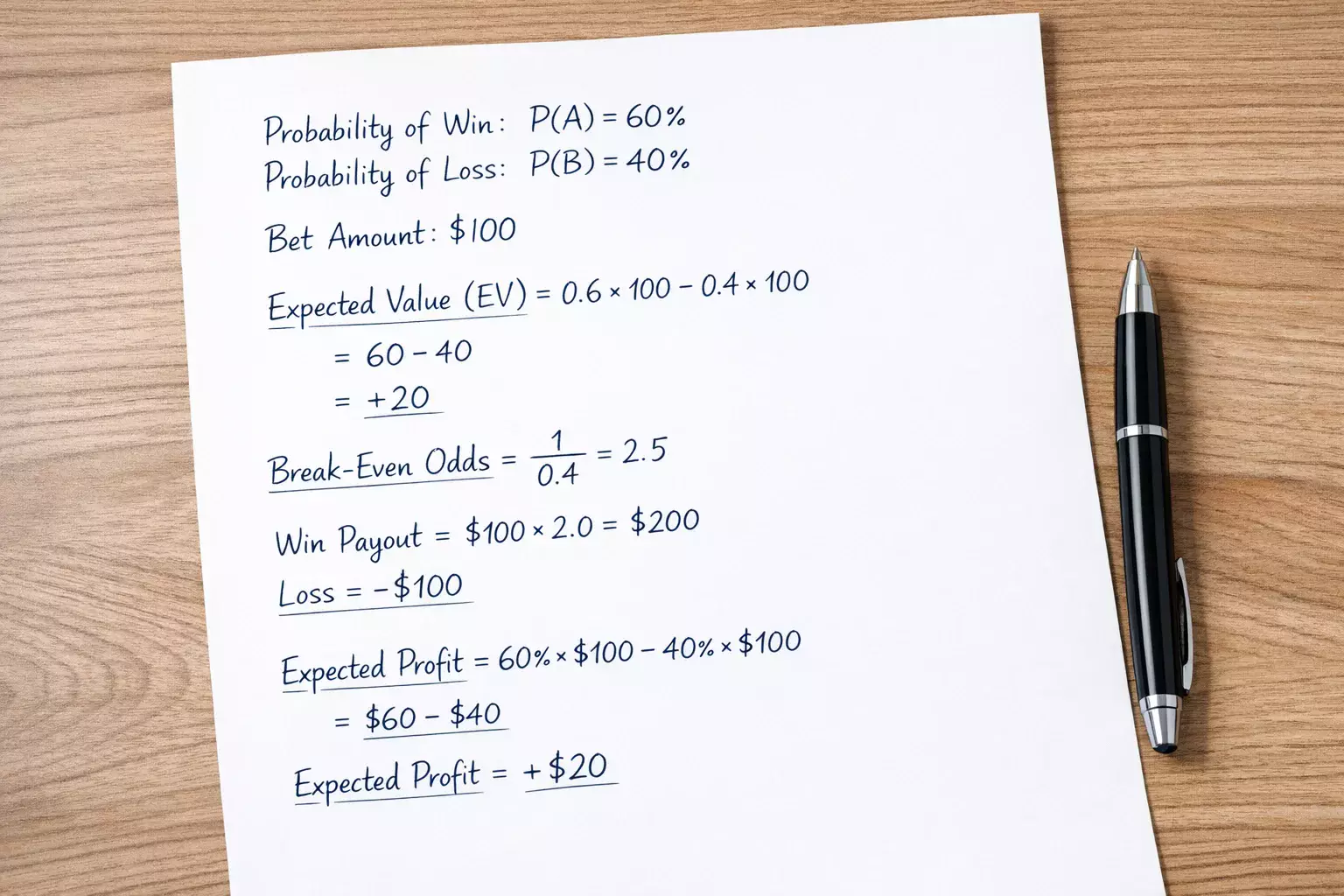
The Kelly Criterion represents perhaps the most mathematically elegant approach to bet sizing ever developed. Created by John Kelly at Bell Labs in 1956 for information theory applications, this formula has since become gospel among professional gamblers and investors seeking optimal capital growth. For football bettors willing to embrace its logic, Kelly provides a framework that theoretically maximises long-term bankroll growth while minimising bankruptcy risk.
Yet Kelly also demands something most bettors cannot provide: accurate probability assessment. The formula requires knowing your true edge, and miscalculating that edge produces stake recommendations that accelerate losses rather than optimising gains. Understanding both Kelly's power and its limitations helps Championship bettors decide whether this sophisticated approach suits their betting reality.
The Kelly Formula Explained
The basic Kelly formula calculates optimal stake as a fraction of bankroll: (bp - q) / b, where b represents decimal odds minus one, p represents your estimated probability of winning, and q represents probability of losing (1 - p). The result indicates what percentage of your bankroll to stake on that particular bet.
Consider a practical example. You've assessed that Coventry City have 60% probability of beating a mid-table opponent, while bookmakers offer 2.00 odds implying 50% probability. Here, b = 1 (odds minus one), p = 0.60, q = 0.40. The Kelly calculation produces (1 × 0.60 - 0.40) / 1 = 0.20, suggesting a 20% bankroll stake.
That 20% recommendation immediately reveals Kelly's aggressive nature. Pure Kelly betting produces significant bankroll volatility because stakes on perceived high-edge bets become substantial. This volatility, while theoretically optimal for maximum growth, proves psychologically challenging and practically risky if probability estimates contain errors.
The formula elegantly produces zero or negative results when no edge exists. If bookmaker odds accurately reflect true probability, Kelly recommends zero stake. If odds imply higher probability than you estimate, Kelly produces negative results indicating the bet should be avoided entirely. This mathematical honesty about edge requirements distinguishes Kelly from systems that ignore value considerations.
Why Kelly Works Mathematically

Kelly optimisation maximises the geometric growth rate of capital over time. Rather than maximising expected value of individual bets, Kelly maximises expected logarithm of wealth — a subtle but crucial distinction that accounts for the compounding nature of sequential betting.
This logarithmic approach inherently protects against bankruptcy. Because Kelly scales stakes to current bankroll and never recommends staking 100%, theoretical bankruptcy becomes impossible regardless of results. Losing bets reduce both bankroll and subsequent stake sizes, creating automatic protection against ruin.
The formula also automatically adjusts for odds and edge magnitude. Higher-edge bets receive larger stakes; marginal edges receive minimal stakes. This proportional response to opportunity quality represents sophisticated capital allocation that simple flat staking cannot match.
Over infinite trials with accurate probability assessment, Kelly-optimal staking produces higher expected bankroll than any alternative staking system. This mathematical proof attracts serious bettors seeking to extract maximum value from their analytical edge.
The Practical Problem: Probability Estimation
Kelly's theoretical elegance crashes into practical reality at a single point: you must accurately estimate true probability. The formula assumes you know something bookmakers don't — that your probability assessment exceeds their implied probability. Overestimating your edge produces dangerously inflated stake recommendations.
Most bettors overestimate their analytical accuracy. Believing you've identified 60% probability when true probability is 55% produces Kelly recommendations roughly 40% higher than optimal. This overconfidence accumulates across bets, producing faster bankroll depletion than flat staking would generate.
Championship betting compounds estimation difficulty. Unlike laboratory probability with precise measurements, football probability involves countless variables that even sophisticated models struggle to quantify. Weather, motivation, injuries, tactical matchups, and random variation all affect outcomes in ways that resist precise probability assignment.
Honest assessment of your probability estimation accuracy proves essential before implementing Kelly. Track your historical predictions against outcomes. If you're consistently overestimating your edge — and most bettors are — Kelly will magnify those errors rather than optimise returns.
Fractional Kelly: The Practical Compromise
Recognising Kelly's sensitivity to estimation error, most practitioners use fractional Kelly — staking some percentage of the full Kelly recommendation. Half-Kelly (50% of calculated stake) and quarter-Kelly (25%) represent common compromises that reduce volatility while capturing some of Kelly's optimisation benefits.
Fractional Kelly trades growth rate for stability. Half-Kelly produces 75% of full Kelly's growth rate while experiencing roughly half the volatility. For bettors uncertain about their probability estimation accuracy, this trade-off often proves worthwhile.
The psychological benefits of fractional Kelly match its mathematical advantages. Full Kelly's aggressive stakes create emotional stress during losing periods, potentially undermining decision-making quality. Fractional approaches feel more sustainable, supporting the long-term perspective that successful betting requires.
Determining appropriate fraction depends on your estimation confidence. Bettors with demonstrated probability accuracy might use half-Kelly; those less certain should consider quarter-Kelly or smaller fractions. The fraction can also vary by market — using smaller fractions for markets where your edge is less certain.
Implementing Kelly for Championship Betting
Begin by establishing your probability estimation method. Whether you use expected goals models, form analysis, or intuitive assessment, you need some systematic approach to estimating true probability that you can compare against bookmaker odds.
Record your probability estimates before checking odds. This sequence prevents anchoring your assessment to market prices and provides honest data about your estimation accuracy. If you estimate 58% probability before seeing 1.80 odds (55.6% implied), you have identified potential value. If you estimate 55% probability before seeing those same odds, Kelly suggests minimal or zero stake.
Calculate Kelly recommendations but apply fractional adjustment. Even confident analysts should probably start with quarter-Kelly to test whether their estimation accuracy justifies more aggressive staking. Track results in both full Kelly and fractional Kelly terms to assess what fraction best matches your actual edge.
Review periodically whether your Kelly-recommended stakes produce expected results. If you're consistently losing more than Kelly mathematics predict, your probability estimates likely contain systematic error. This feedback should inform both future estimates and fraction selection.
When Kelly Doesn't Apply
Kelly assumes you can bet precisely your calculated amount, but practical constraints often prevent this. Bookmaker limits may cap stakes below Kelly recommendations on high-edge bets. Minimum stakes may exceed Kelly recommendations on marginal edges. These constraints require adaptation from pure Kelly implementation.
The formula also assumes sequential independent bets, but real football betting involves correlated outcomes. Betting Kelly-optimal stakes on multiple matches in the same gameweek creates correlated exposure that violates Kelly assumptions. Adjusting for this correlation requires sophisticated portfolio approaches beyond basic Kelly.
Kelly optimises for long-term growth, ignoring short-term drawdown preferences. Some bettors reasonably prefer smoother equity curves even at the cost of lower theoretical growth. Kelly doesn't accommodate these preferences — it maximises terminal wealth without regard for the journey's bumpiness.
Recreational bettors seeking entertainment rather than optimal growth shouldn't feel obligated to use Kelly. The formula suits those treating betting as serious wealth accumulation; casual punters may find its requirements burdensome without matching returns.
Kelly Within Broader Strategy

Kelly addresses stake sizing but says nothing about selection quality. The most sophisticated Kelly implementation applied to poor value bets still loses money — it just loses optimally. Kelly enhances good selection; it cannot replace it.
Combining Kelly with unit-based thinking helps manage its volatility. Rather than thinking in bankroll percentages, think of full Kelly as perhaps 3 units, half Kelly as 1.5 units, and quarter Kelly as standard 1-unit bets. This mental framework maintains Kelly's proportional logic while connecting to familiar staking concepts.
Kelly naturally reduces stakes as bankroll decreases, providing automatic loss-limiting. However, this protection only functions if you actually follow Kelly recommendations through losing periods. The temptation to increase stakes to recover losses undermines Kelly's mathematical elegance.
Documentation becomes essential for Kelly users. Recording probability estimates, Kelly calculations, fraction applied, and outcomes enables the performance analysis that reveals whether your implementation produces expected results.
Realistic Kelly Expectations
Kelly doesn't guarantee profits — it optimises stake sizing given accurate probability estimates. If you lack genuine edge, Kelly-optimal staking of zero edge produces zero expected profit. The formula cannot create edge; it can only extract maximum value from edge that exists.
Short-term results under Kelly remain highly variable. The same mathematical properties that produce optimal long-term growth allow substantial drawdowns over shorter periods. Bettors must commit to Kelly across hundreds of bets to assess whether it's working — judging after a few weeks provides meaningless signal.
Kelly works best for bettors with demonstrated analytical edge and the discipline to implement it consistently. Those uncertain whether they possess genuine edge should probably stick with simpler flat staking until track record evidence supports more sophisticated approaches.
The Kelly Criterion offers Championship bettors a mathematically optimal approach to stake sizing that maximises long-term growth while preventing bankruptcy. Its elegance comes with significant practical requirements — accurate probability estimation and psychological resilience through volatility — that limit its suitability to serious bettors willing to invest effort in implementation. For those who can meet these requirements, Kelly provides structure that transforms good analysis into optimal results.
