
Unit Betting System: How to Size Your Football Bets for Long-Term Success
 Available in US
The question of how much to wager on any given bet separates recreational gamblers from serious bettors more definitively than selection quality ever could. You might identify value perfectly yet still lose money through poor stake management. Conversely, disciplined staking can maintain profitability even through periods of below-average selection accuracy. The unit betting system provides the structural framework that transforms chaotic wagering into systematic investment.
Most bettors approach stake sizing emotionally rather than mathematically. They bet more when confident, less when uncertain, and dramatically more when chasing losses. This inconsistency guarantees that wins and losses don't properly represent edge quality. A brilliant selection at minimal stake contributes less than a mediocre pick at maximum stake. The unit system eliminates this emotional interference by standardising bet sizes around predetermined amounts.
Understanding Units and Their Purpose
A unit represents a standardised stake amount calculated as a percentage of your total betting bankroll. Rather than thinking in pounds or dollars, unit-based bettors think in percentages. This reframing proves psychologically powerful because it maintains consistent risk regardless of bankroll fluctuations and removes the emotional weight that specific currency amounts carry.
The standard recommendation places one unit between 1% and 3% of total bankroll. Conservative bettors use 1% units, accepting slower potential growth in exchange for reduced volatility. Aggressive bettors might use 3% units, accepting higher variance for faster potential bankroll expansion. Most serious bettors settle around 2%, balancing growth potential with survival probability.
Calculating your unit size requires honest bankroll assessment. If you've dedicated £500 to football betting, a 2% unit equals £10. Every standard bet you place should be £10, regardless of confidence level or perceived edge size. This consistency creates the foundation upon which systematic betting operates.
The psychological benefit of unit thinking extends beyond stake calculation. Tracking results in units rather than currency reveals true performance independent of stake variation. A bettor winning 15 units over a season demonstrates clear edge regardless of whether their unit represents £5 or £500. This standardisation enables meaningful comparison across bettors and time periods.
Implementing Units in Practice
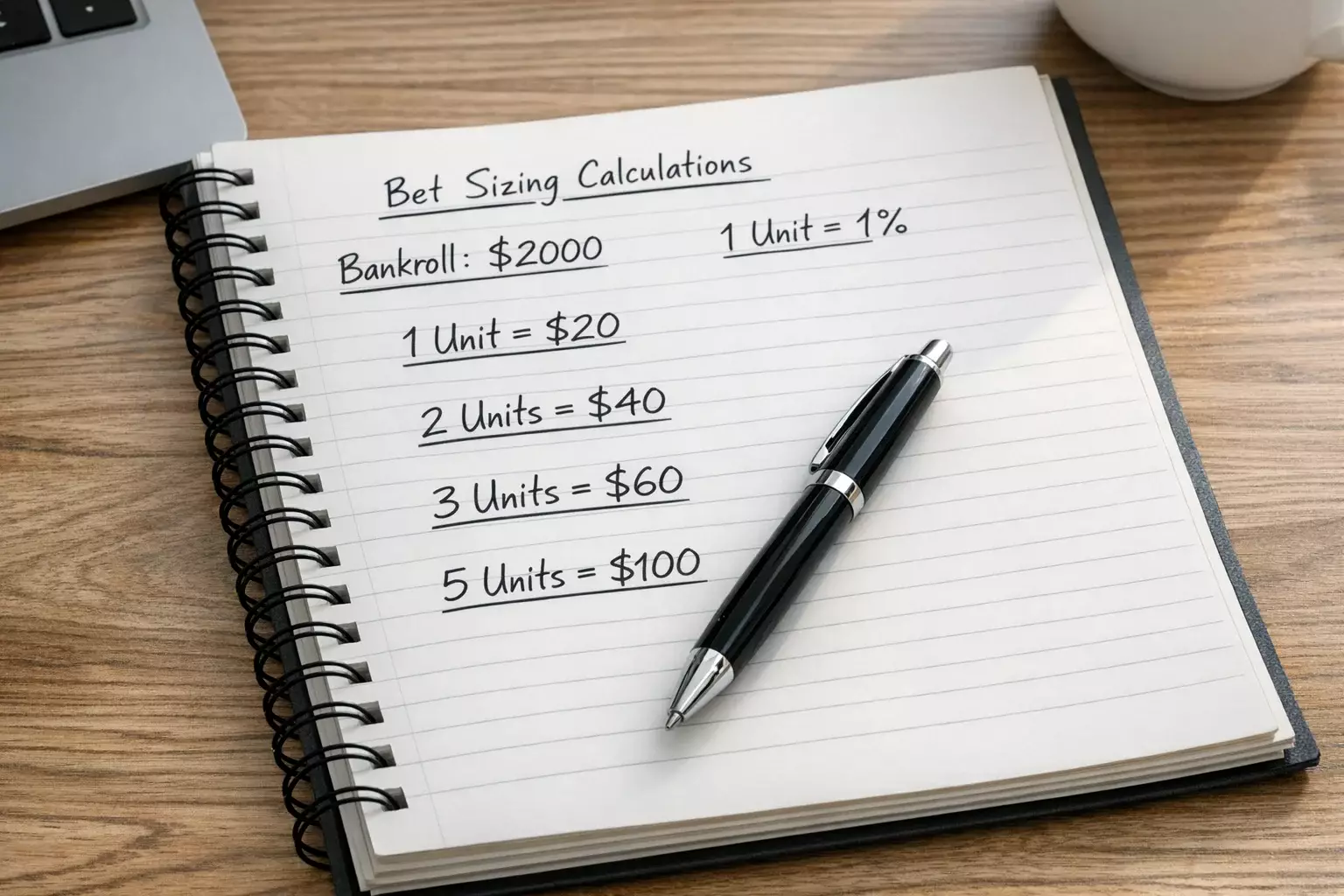
Begin by establishing your bankroll as genuinely disposable income. This amount should represent money you can lose entirely without affecting your financial security or emotional wellbeing. Betting with rent money or savings isn't just financially dangerous — it creates psychological pressure that undermines decision-making quality.
Once bankroll is established, calculate your unit size and commit to it completely. Write down both figures and keep them visible when placing bets. The written commitment provides accountability that mental notes cannot match. When temptation strikes to increase stakes on a "sure thing," the written unit size serves as external discipline.
Recalculating units should occur periodically rather than constantly. Monthly recalculation works well for most bettors — frequent enough to reflect bankroll changes but not so frequent that every bet affects subsequent stake sizes. If your £500 bankroll grows to £600, your 2% unit increases from £10 to £12 at month end. If it drops to £400, units decrease to £8.
Avoid the temptation to recalculate only when bankroll increases. This selective adjustment, raising stakes after wins while maintaining them after losses, represents a subtle form of martingale thinking that compounds negative variance. True unit discipline requires accepting stake decreases during losing periods as readily as increases during winning periods.
Variable Unit Systems
While pure flat staking uses identical unit amounts for every bet, variable unit systems allow stake adjustment based on perceived edge or confidence. These systems introduce complexity but potentially improve capital allocation for bettors capable of accurately assessing their own edge.
The simplest variable system uses a 1-3 unit scale. Standard bets receive 1 unit, strong selections receive 2 units, and exceptional opportunities receive 3 units. This bounded variation prevents the extreme stake fluctuations that undermine bankroll stability while allowing increased exposure to perceived high-value situations.
Implementing variable units requires rigorous honesty about confidence calibration. Most bettors overestimate their ability to identify strong versus exceptional opportunities. Track your results separately for different unit levels to verify whether higher-unit bets actually produce better returns. If your 3-unit selections underperform your 1-unit picks, your confidence calibration needs adjustment.
The danger of variable systems lies in gradual stakes creep. What begins as 1-3 units slowly becomes 2-4, then 3-5, as confidence grows and previous stakes feel insufficiently exciting. Maintaining original boundaries requires conscious effort and periodic review of staking patterns.
Unit Systems for Different Bet Types
Single bets represent the clearest unit application — one selection, one unit (or variable units based on your system). The calculation is straightforward and the risk is transparent. Most serious bettors concentrate their activity in singles because they provide the clearest connection between selection quality and results.
Accumulator betting complicates unit calculation because risk compounds across selections. A four-fold accumulator at 2.00 per leg produces 16.00 combined odds, but the probability of all four landing sits around 6.25% rather than the roughly 50% each individual leg implies. Treating accumulators as entertainment rather than strategy, with stakes capped at 0.5 units regardless of leg count, acknowledges their mathematical disadvantages.
Bet builders function similarly to accumulators in risk terms. Multiple selections from one match compound failure probability even when correlation provides some protection. Applying reduced unit sizes — perhaps 0.5 to 1 unit maximum — reflects the enhanced variance these combinations introduce.
Each-way and place betting in relevant markets requires unit adjustment for the split stake nature. A 1-unit each-way bet actually risks 2 units total (1 for win, 1 for place). Accounting for this accurately prevents unintentional overexposure.
Common Unit System Mistakes
The most frequent error involves setting units too high relative to bankroll. Eager bettors wanting meaningful returns from modest bankrolls set 5% units, then discover that a ten-bet losing streak — entirely possible even with positive edge — wipes out half their capital. Conservative unit sizing feels slow but enables survival through inevitable variance.
Abandoning units during winning streaks represents another common failure. Success breeds confidence, confidence breeds increased stakes, and increased stakes magnify the losses that inevitably follow hot runs. The unit system works precisely because it resists emotional impulses in both directions — restraining excitement during wins and panic during losses.
Treating different markets with different implicit unit values undermines systematic discipline. A bettor might consciously use £10 units for match bets but unconsciously use £20 for accumulators because the potential returns seem more exciting. Maintaining awareness of actual unit values across all bet types requires active attention.
Failing to track results in unit terms prevents meaningful performance assessment. Recording that you won £47 last month tells you little; recording that you won 4.7 units reveals actual performance relative to risk taken. Unit-based tracking enables comparison across time periods when absolute bankroll may have varied significantly.
Long-Term Unit System Benefits

Bankroll longevity increases dramatically under unit discipline. A bettor using consistent 2% units needs to lose 50 consecutive bets to experience bankruptcy — statistically unlikely even with zero edge. This survival buffer allows for natural variance without forced retirement from betting activity.
Emotional stability improves when individual bet outcomes carry standardised significance. Whether today's bet wins or loses, it represents the same 2% bankroll movement. This consistency reduces the psychological peaks and valleys that drive poor decision-making and prevent objective selection assessment.
Performance clarity emerges from unit-based record keeping. Knowing you've produced +23.5 units over 500 bets at 2% stakes tells you precisely what your edge is and what future expectations should be. This clarity supports rational bankroll decisions about whether to continue, adjust approach, or recognise that edge may not exist.
Professional development becomes possible when systematic staking removes noise from signal. You can genuinely assess selection approaches because stake variation isn't contaminating results. The feedback loop between selection quality and outcomes becomes clean enough to support learning and improvement.
Practical Implementation Guide
Start with honest bankroll assessment today. Write down the specific amount you're dedicating to football betting — money that could disappear entirely without affecting your life. If that number feels uncomfortable, it's too high. Reduce until the figure represents genuinely disposable entertainment spending.
Calculate your unit size at 2% of that bankroll. Write this figure alongside your bankroll amount. Commit to using this unit size for all standard bets, with any variable system clearly defined in advance rather than decided in the moment.
Create a simple tracking spreadsheet recording every bet with unit stake, odds, and outcome. Calculate running unit profit/loss alongside currency figures. Review monthly to recalculate unit sizes based on current bankroll and assess whether your staking discipline has held.
Accept that unit-based betting feels slower and less exciting than emotional stake variation. That slower, less exciting feeling is precisely the point — it's the feeling of discipline replacing impulse, and discipline is what separates bettors who survive from those who don't.
The unit betting system provides Championship bettors with the structural foundation that makes long-term success possible. It won't improve your selections, but it will ensure that good selections actually produce appropriate returns and that bad selections don't cause disproportionate damage. In a pursuit where most participants eventually go broke, the unit system represents your best protection against becoming another bankroll casualty.
